The 3 Things Teachers Notice First
A polished essay is important—but an essay that sounds authentically yours is even more convincing. Many AI-assisted essays fail not because the ideas are weak, but because every paragraph feels equally perfect, predictable, and detached from the writer. Before your instructor reads your references or checks your grammar, they often notice whether the writing feels like it came from a real student.
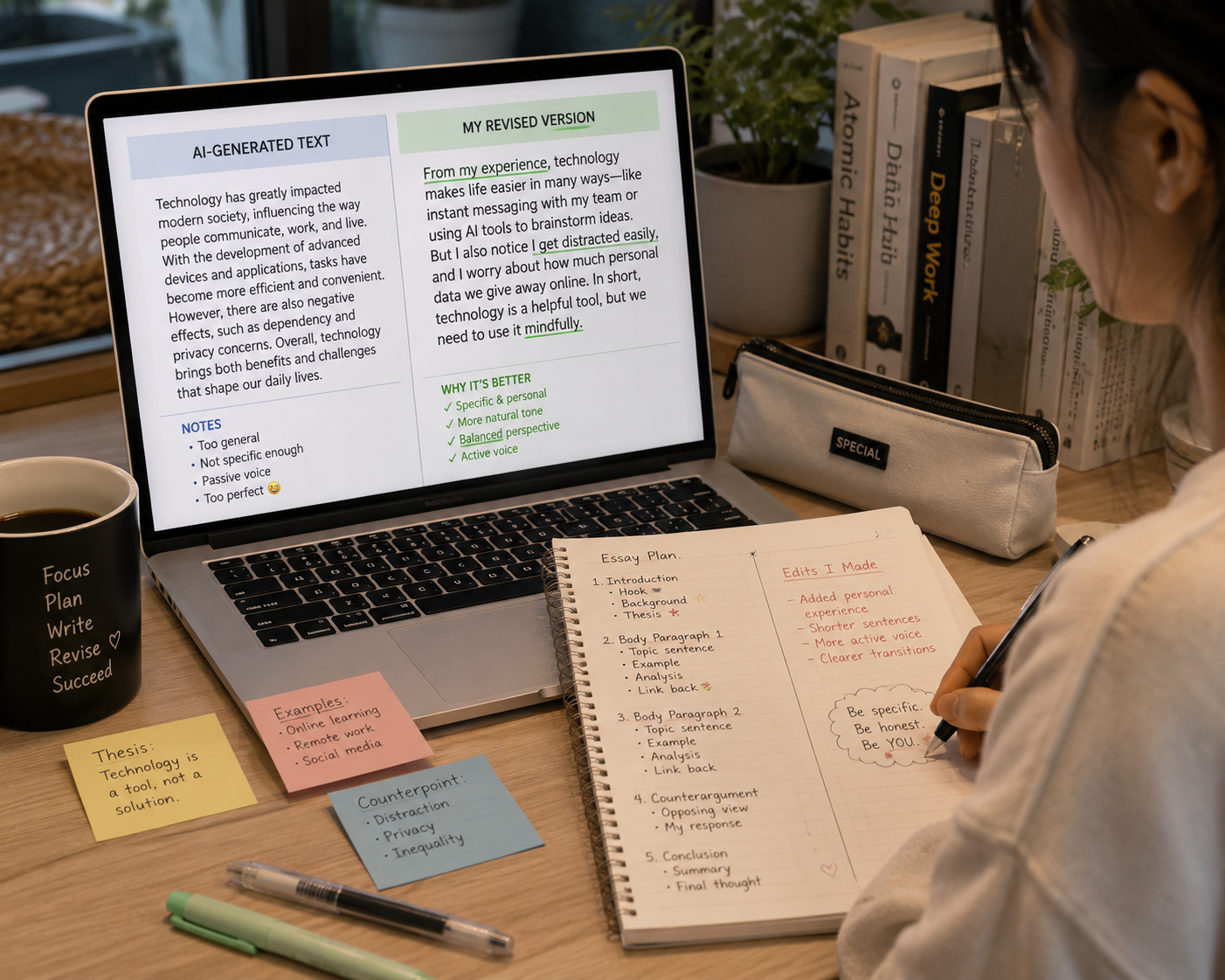
Part 1. Three Writing Habits That Make an Essay Sound Human
1. Start by Answering the Question Directly
One of the biggest mistakes AI-generated essays make is spending an entire introduction discussing broad background information before addressing the actual assignment.
Instead of writing several generic sentences about technology, education, or society, identify the specific case immediately.
For example:
This essay looks at how TikTok study content shapes international students’ daily routines.
Within a single sentence, the reader already understands:
- Which case you’re discussing
- Which group you’re focusing on
- What academic idea the essay explores
This creates confidence because it sounds like someone who has already decided what argument they want to make.
Compare the two openings:
Too genericSocial media has become an important part of modern education across the world.
More personal
This essay examines how TikTok study communities influence the study habits of first-year international students in Australian universities.
The second version immediately feels more intentional.
2. Give Every Paragraph a Small Job
Many AI essays simply summarize readings one after another.
Human writers usually do something with the evidence.
Instead of only introducing a source, try to:
- Compare two viewpoints
- Explain why the evidence matters
- Question a limitation
- Connect ideas together
- Apply theory to a real example
After presenting evidence, add one sentence that reflects your own thinking.
Examples include:This matters because…
It suggests that…
However, this only works when…
These tiny transitions make a huge difference.
Instead of sounding like a list of quotations, your essay becomes an ongoing conversation between ideas.
3. Leave Some Boundaries in the Conclusion
Many AI-generated conclusions simply repeat earlier paragraphs.
Real academic writing often ends by acknowledging limits.
For example:
This view helps explain the classroom case, but it may not apply to students from very different language backgrounds.
Or:
Further research could examine whether these findings remain consistent across different educational systems.
Adding a realistic limitation shows critical thinking.
Ironically, essays that admit small uncertainties often sound more confident, because genuine academic writers rarely claim their conclusions explain everything.
A Small Tip
If every paragraph looks like a perfect textbook example, your essay may actually appear less authentic.
Real students make choices.
They emphasize certain ideas.
They acknowledge limitations.
They sometimes leave interesting questions unanswered.
That balance often makes writing feel much more natural.
Part 2. Use a Humanizer Tool to Make Your Essay Sound More Natural
Even after careful editing, AI-generated writing often retains patterns that feel unusually mechanical. Sentences may have nearly identical lengths, transitions appear too polished, and every paragraph follows the same predictable rhythm. These characteristics can make an essay read more like a generated document than a genuine piece of student writing.
A Humanizer tool is designed to improve those patterns rather than completely rewrite your work. Instead of changing your ideas, it focuses on making the writing flow more naturally. It may vary sentence length, soften repetitive transitions, reduce formulaic phrasing, and introduce more realistic variation in style while preserving the original meaning.
The most effective workflow is to treat the Humanizer as a final editing stage rather than the starting point. First, develop your own argument, add course-specific examples, and include personal analysis. Once the structure is complete, run the finished draft through the Humanizer to smooth the language. Afterwards, read every paragraph yourself and make additional adjustments where necessary. Small edits—such as replacing overly formal expressions, adding a brief explanation, or shortening repetitive sentences—help preserve your own writing voice.
Remember that no tool can replace critical thinking. A Humanizer improves readability, but the strongest essays still come from original ideas, thoughtful analysis, and careful engagement with course materials. Think of it as an editing assistant rather than an author.
Part 3. Check Your Essay with TurnDetector Before Submission
Before submitting your assignment, it’s worth checking how your writing appears from the perspective of AI-detection software. While no detector can perfectly identify AI-generated content, running a self-check allows you to spot sections that may appear unusually repetitive or machine-like before your instructor sees them.
TurnDetector works as a pre-submission review tool. Rather than treating the score as a final judgment, use the report to identify patterns. If a particular paragraph receives a higher AI likelihood, examine why. Common reasons include repetitive sentence structures, excessive use of transition phrases, generic topic sentences, or long sequences of perfectly balanced sentences. These sections usually benefit from targeted revision instead of complete rewriting.
A practical workflow is simple. Draft your essay, revise the argument yourself, use a Humanizer to improve the writing style, then run TurnDetector. Focus only on paragraphs that appear unusually consistent or formulaic. Replace generic expressions with course-specific examples, explain why the evidence matters, and add your own interpretation. Often, only a few thoughtful edits can make the writing feel significantly more authentic.
Finally, remember that AI detection scores should never become your primary goal. An essay should first satisfy the assignment requirements, demonstrate critical thinking, and accurately represent your understanding of the topic. Detection tools are most valuable when they support good writing—not when they replace it.
Final Thoughts
Teachers rarely decide whether an essay feels authentic because of a single sentence.
Instead, they notice dozens of small signals:
- Does the introduction answer the question immediately?
- Does every paragraph contribute something beyond summarizing sources?
- Does the conclusion acknowledge realistic limitations?
- Does the writing sound like someone genuinely thinking through the topic?
When your essay reflects these habits, it doesn’t just appear more natural—it also demonstrates stronger academic reasoning. AI can help you draft ideas, but your revisions, judgment, and critical thinking are what ultimately make the paper sound like you.
Useful Tools
- Essay Humanizer - Make your essay sound more human-written
- AI Detector - Check if your text sounds AI-generated
- Free Citation Generator - Generate citations in multiple formats
- Math Solver - Solve math problems step by step