Ever wonder what happens to your paper after you hit “submit” on Turnitin or similar platforms? Spoiler: it’s not reading your essay like a teacher would.
Let’s be real—AI in academic integrity tools is one of those topics wrapped in mystery and a few myths. So let’s clear things up in plain English.
What “AI” Actually Means Here
When platforms like Turnitin talk about AI, they’re usually referring to two different things:
- The massive reference index — basically a giant library of billions of papers, websites, and articles used to find matches
- Actual machine learning models — trained to spot patterns that suggest AI-generated writing or unusual stylistic changes
The first part? That’s mostly smart indexing and string matching—not the sci-fi stuff. The second part is where the actual AI lives, and it’s more interesting than you might think.
So Where Do All Those Papers Come From?
Here’s the deal: over years and years, these platforms have collected submissions from schools and universities worldwide. When you submit a paper, it often gets stored in a “repository” to help check future submissions for similarity.
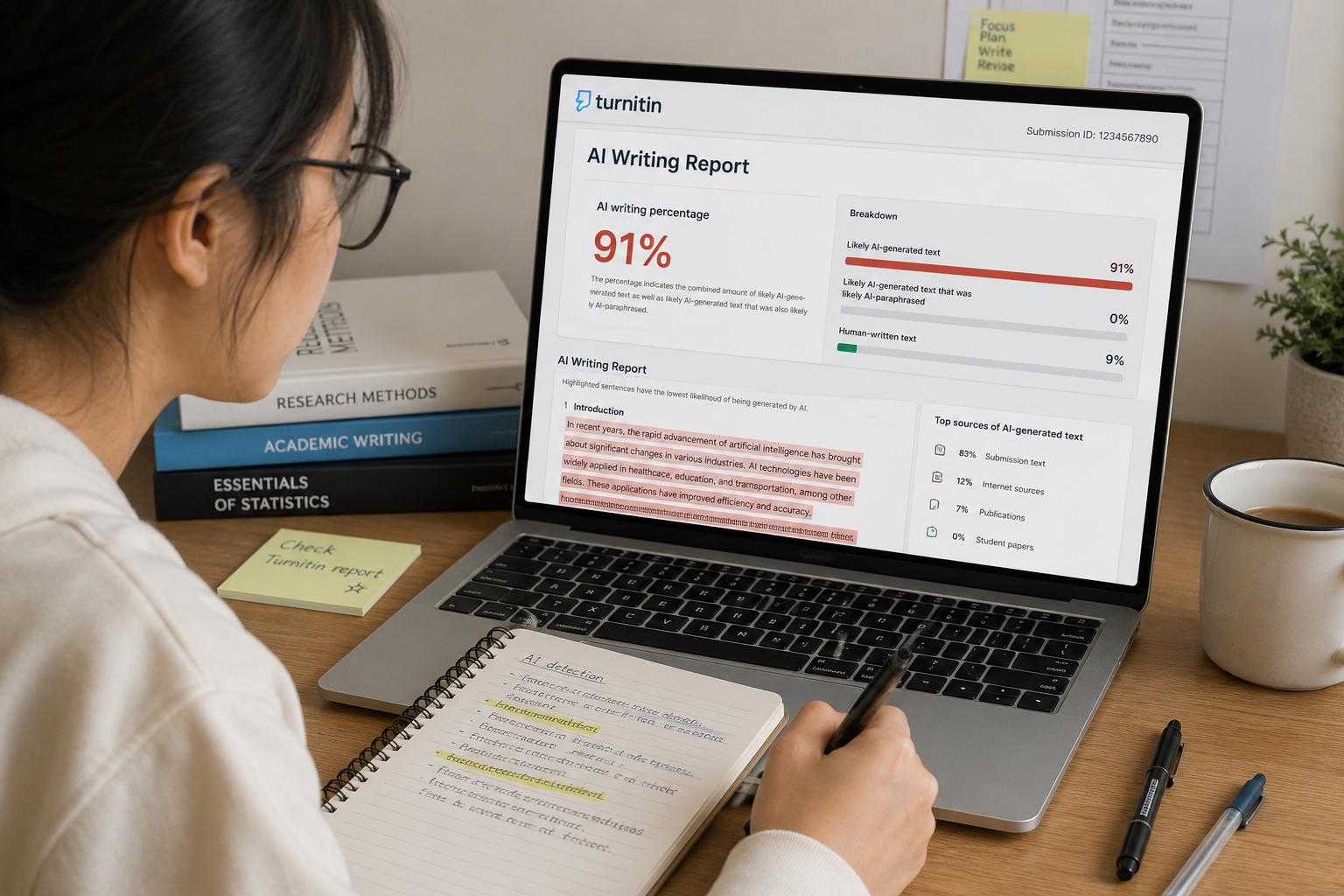
But here’s what most people don’t realize—those papers aren’t just dumped into a training machine. The repository exists primarily for comparison purposes. Think of it like a library’s catalog system: it helps find matches, but the books aren’t being rewritten.
Platforms also tap into:
- Web content and published articles
- Partnerships with academic publishers
- Public datasets and open-source text collections
How Do They Actually Detect AI Writing?
Now this is the cool part. AI writing detectors don’t just “know” when something was written by ChatGPT. They look for statistical fingerprints—like:
- Sentence uniformity: AI often writes with more consistent sentence lengths
- Burstiness patterns: Human writing tends to vary more between short punchy sentences and longer complex ones
- Lexical choices: AI might overuse certain transitions or phrase structures
The models get trained on datasets full of both human-written and AI-generated text, learning to spot these statistical differences. It’s not perfect—honestly, it can’t be—but it’s getting better as the technology evolves.
The Privacy Stuff Actually Matters
This is where it gets serious. Educational data is protected by laws like FERPA (in the US) and GDPR (in Europe). Here’s what that means in practice:
- Students typically retain copyright to their work
- Institutions control whether papers go into repositories
- Access to raw submissions is heavily audited and restricted
- Training datasets usually come from consented, public, or synthetic sources
So no—your professors aren’t secretly training supercomputers on your freshman composition essays.
What This Means For You
For students:
- Use those similarity reports! They’re actually helpful for learning proper citation
- Keep drafts and notes—your process matters
- If AI assistance is allowed, be upfront about it
For educators: - Think of detection scores as one signal, not a verdict
- Combine multiple tools: rubrics, drafts, and good old-fashioned conversations
- Design assignments that let students show their actual thinking
The Bottom Line
AI in academic integrity isn’t some mysterious black box eating student work. It’s a layered system—part massive search engine, part statistical analysis tool, part privacy-conscious data steward.
Will it always be right? No. But understanding how it works takes away some of the fear and lets us use it more responsibly.
The real takeaway? These tools work best when they support good teaching practices, not replace them. Your voice, your thinking, your process—that’s still what matters most.
What questions do you have about how academic integrity tools work? Drop them in the comments below!
Useful Tools
- Essay Humanizer - Make your essay sound more human-written
- AI Detector - Check if your text sounds AI-generated
- Free Citation Generator - Generate citations in multiple formats
- Math Solver - Solve math problems step by step