Understanding the Evolution of AI-Generated Content
The landscape of content creation has undergone a dramatic transformation in recent years. Artificial intelligence has emerged as a powerful tool for writers, marketers, students, and professionals across virtually every industry. At the forefront of this revolution stands ChatGPT, OpenAI’s groundbreaking language model that has revolutionized how we interact with machines and create written content. However, as AI-generated text becomes increasingly prevalent, a new challenge has emerged: making this content indistinguishable from human writing. This challenge has given rise to a new category of tools and technologies collectively known as AI Humanizers.
In this comprehensive guide, we will explore the fundamental principles behind ChatGPT’s text generation capabilities, examine the latest research and developments in AI Humanization technology, and provide a detailed comparison between these two approaches. Whether you’re a content creator looking to enhance your workflow, an academic professional seeking to understand the nuances of AI writing, or a business leader navigating the complexities of AI adoption, this article will equip you with the knowledge needed to make informed decisions about AI content creation and humanization.
Part 1: Understanding ChatGPT — Architecture, Principles, and Capabilities
The Foundation: Large Language Models and Transformer Architecture
ChatGPT is built upon the Transformer architecture, a neural network model that has fundamentally revolutionized natural language processing tasks since its introduction. The Transformer employs a mechanism called self-attention, which allows the model to consider the relationships between all words in a sequence simultaneously, rather than processing them sequentially as in earlier models. This architecture enables ChatGPT to capture long-range dependencies and contextual nuances with remarkable efficiency.
The underlying technology behind ChatGPT is a Large Language Model (LLM) trained on vast amounts of text data from the internet, books, articles, and various other sources. This training exposes the model to billions of parameters, enabling it to learn patterns, structures, and relationships within human language. The model’s ability to generate coherent, contextually appropriate responses stems from its capacity to predict the next word in a sequence based on all preceding words—a task known as language modeling.
Reinforcement Learning from Human Feedback (RLHF)
What sets ChatGPT apart from earlier language models is its refinement through Reinforcement Learning from Human Feedback. This training methodology involves human AI trainers who rank different model responses based on quality, helpfulness, and appropriateness. These rankings are then used to fine-tune the model’s behavior, helping it align more closely with human preferences and expectations.
The RLHF process addresses several limitations that plagued earlier AI systems. It reduces the likelihood of generating harmful, biased, or inappropriate content. It improves the model’s ability to follow instructions and engage in meaningful, contextually appropriate conversations. Additionally, it helps the model develop a more natural, conversational tone that users find engaging and useful.
How ChatGPT Generates Text
When you input a prompt into ChatGPT, the model processes your text through multiple layers of neural networks. Each layer extracts increasingly abstract features and relationships from the input. The model then uses its learned knowledge to generate probability distributions over possible next tokens (typically words or subwords). The final output is selected through a combination of sampling techniques and, in some cases, additional constraints to ensure quality and relevance.
While the resulting text is often impressive in its coherence and apparent understanding, experienced readers can sometimes identify AI-generated content based on certain characteristics. These include overly formal or generic phrasing, a tendency toward verbose explanations, the absence of personal anecdotes or unique perspectives, and a sometimes predictable structure that follows common templates.
Neural network visualization representing the complex architecture underlying large language models like ChatGPT
Part 2: The Science of AI Humanization — Principles and Latest Research
Defining AI Humanization
AI Humanization refers to the process of transforming AI-generated content to make it appear more natural, engaging, and indistinguishable from human-written text. This process addresses a critical challenge in the AI content ecosystem: the growing sophistication of AI detection tools that can identify content produced by artificial intelligence.
Research in this field has accelerated dramatically as educators, publishers, and platform administrators seek ways to distinguish between human and AI-generated content. Studies have systematically quantified and compared linguistic features between human-written and AI-generated language, revealing subtle but detectable differences in vocabulary choice, sentence structure, paragraph organization, and rhetorical patterns.
Key Principles of Effective Humanization
The most effective AI humanization approaches focus on several key areas:
Variability in Sentence Structure: AI-generated text often exhibits overly consistent sentence lengths and structures. Human writing naturally varies in complexity, length, and construction. Effective humanization introduces this variability while maintaining coherence and flow.
Personal Voice and Perspective: Human writing typically reflects individual experiences, opinions, and perspectives. AI content often lacks this personal touch, presenting information in a detached, objective manner. Humanization techniques encourage the incorporation of first-person perspectives, personal anecdotes, and subjective observations.
Natural Language Patterns: Humans frequently use contractions, colloquialisms, and informal expressions that AI systems sometimes avoid or implement awkwardly. Effective humanization introduces these patterns authentically without compromising professionalism or clarity.
Emotional Resonance: Human writers naturally incorporate emotional elements, humor, and empathy into their writing. AI content tends toward neutrality and objectivity. Humanization encourages the strategic introduction of emotional elements appropriate to the context and audience.
Latest Research on AI Text Detection and Humanization
Recent scholarly work has examined the linguistic components represented in both AI-generated and human-written texts, providing valuable insights into how artificial intelligence attempts to emulate human writing patterns. This research has proven instrumental in developing both more sophisticated detection tools and more effective humanization techniques.
The arms race between AI detection and humanization has led to increasingly sophisticated approaches on both sides. Modern humanization tools employ advanced algorithms that analyze text at multiple levels—from surface-level punctuation and capitalization to deep-level semantic patterns and rhetorical structures. The goal is not merely to avoid detection but to create content that genuinely engages readers through authentic human expression.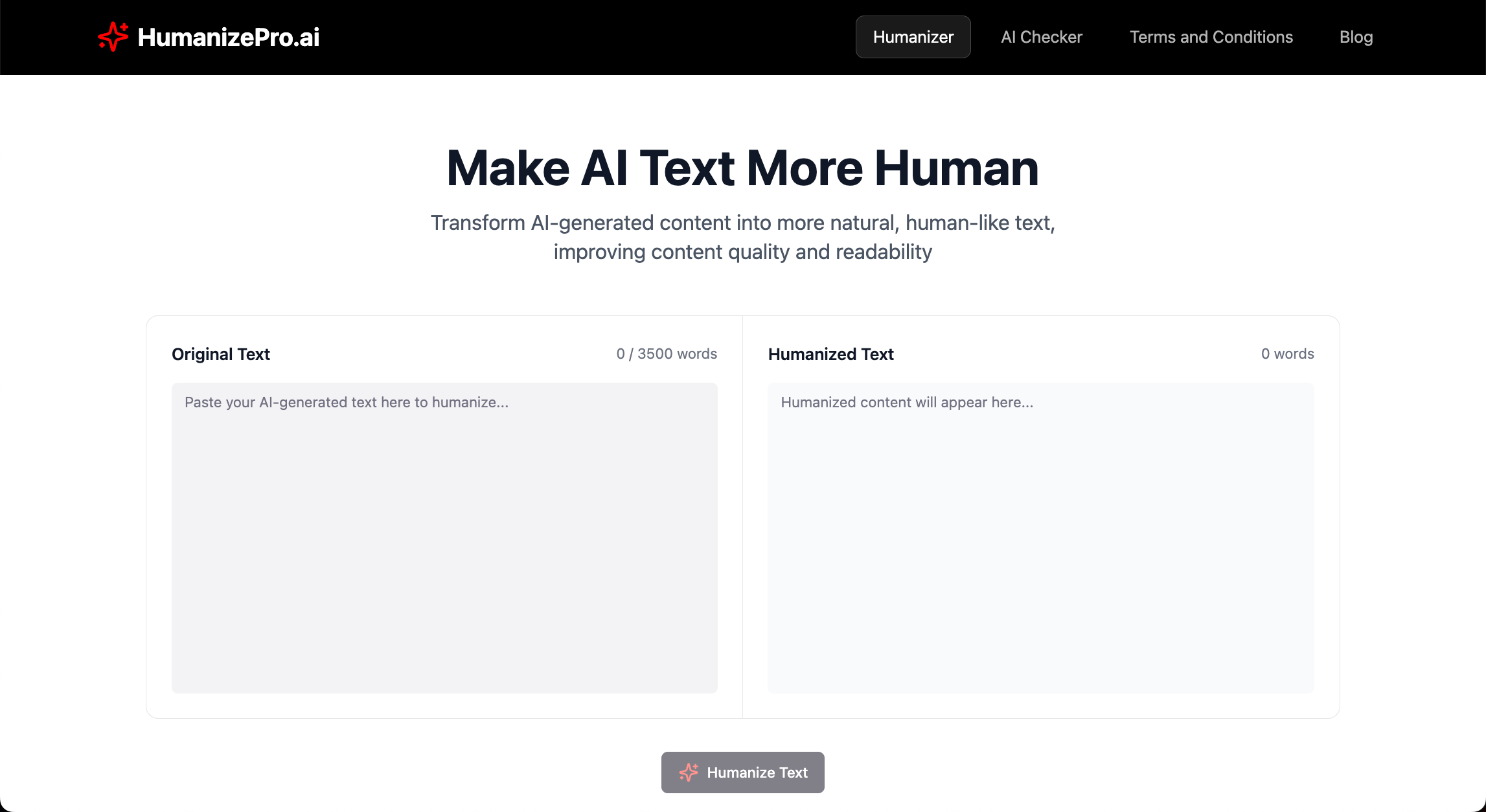
The intersection of artificial intelligence and human creativity in text generation
Part 3: ChatGPT vs Humanize — A Comprehensive Comparison
Fundamental Differences in Approach
While both ChatGPT and Humanize AI tools relate to AI-generated content, they serve fundamentally different purposes and operate on different principles.
ChatGPT is a generative AI system designed to create content from scratch based on user prompts. Its strength lies in its ability to produce coherent, informative, and contextually appropriate text on virtually any topic. ChatGPT excels at drafting initial content, brainstorming ideas, and generating text that meets general quality standards.
Humanize tools, on the other hand, are designed to take existing AI-generated content and transform it to sound more natural and human-written. Rather than generating content, these tools process and refine output from generative AI systems like ChatGPT, Claude, and Gemini to enhance its authenticity and bypass AI detection systems.
When to Use Each Approach
Understanding when to use generative AI versus humanization tools is crucial for optimizing your content creation workflow:
Use ChatGPT (or similar generative AI) when:
- You need to create content from scratch
- You’re brainstorming and need initial drafts
- You want to explore multiple perspectives on a topic
- You need quick generation of informative content
- You’re working with structured formats like outlines, summaries, or standard business documents
Use Humanize tools when: - You’ve already generated content with AI and want to enhance its naturalness
- You need to ensure content passes AI detection checks
- You want to add personal voice and authentic human touches
- You’re preparing content for contexts where AI detection is a concern
- You need to refine AI output for academic, professional, or creative applications
The Humanize Advantage
Humanize technology offers several distinct advantages that complement generative AI:
Authenticity Enhancement: Humanize tools transform generic AI output into content with genuine human character, incorporating varied sentence structures, personal perspectives, and natural language patterns that resonate with readers.
Detection Bypass: Perhaps the most practical advantage, humanization tools can significantly reduce the likelihood of AI detection, which is increasingly important in academic, professional, and publishing contexts where originality is valued.
Time Efficiency: Rather than completely rewriting AI-generated content, humanization tools allow you to maintain the efficiency of AI-assisted writing while achieving the authenticity of human-crafted text.
Voice Consistency: Advanced humanization tools can help maintain consistent authorial voice across different pieces of content, ensuring that your brand or personal style remains recognizable even when using AI assistance.
Part 4: Humanize Best Practices — A Complete Guide
Strategic Humanization Framework
Based on comprehensive research and expert analysis, implementing effective humanization requires a strategic approach that balances authenticity with efficiency. The following best practices will help you achieve optimal results when humanizing AI-generated content.
1. Start with Quality AI Output
The effectiveness of humanization depends significantly on the quality of the initial AI-generated content. Before applying humanization techniques, ensure your source content meets basic quality standards:
- Clear prompts yield better output: Provide detailed, well-structured prompts to your generative AI to receive higher-quality initial drafts
- Review before humanizing: Read through AI output and correct obvious errors or inconsistencies before the humanization process
- Maintain core meaning: Ensure the AI-generated content accurately conveys your intended message before transformation
2. Focus on Natural Flow
One of the most detectable characteristics of AI-generated text is its tendency toward formulaic structure and predictable transitions. Effective humanization addresses this through:
- Varied sentence openings: Avoid starting multiple sentences with the same words or phrases
- Diverse transition styles: Use varied transition words and phrases rather than repeating the same few options
- Organic paragraph breaks: Allow paragraphs to flow naturally rather than following rigid templates
3. Inject Personal Elements
Human writing naturally incorporates personal experiences, opinions, and perspectives. Enhance AI content by:
- Adding first-person perspective where appropriate
- Incorporating relevant anecdotes or examples from personal experience
- Expressing opinions and viewpoints on the subject matter
- Acknowledging limitations or uncertainties in your knowledge
4. Adjust Tone and Style
AI-generated content often maintains a consistent, neutral tone that can feel impersonal. Humanization should adjust:
- Formality levels to match your audience and purpose
- Emotional resonance appropriate to the content type
- Vocabulary choices to reflect natural speech patterns
- Rhetorical strategies based on genre conventions
5. Verify Detection Resistance
After humanization, test your content against common AI detection tools to ensure effectiveness:
- Multiple detection platforms: Test content across various AI detection systems
- Iterative refinement: If detected, adjust humanization parameters and re-test
- Balance authenticity and detection: Ensure humanization doesn’t compromise content quality or accuracy
6. Maintain Professional Standards
While humanization aims to create natural-sounding content, maintain professional integrity:
- Accuracy preservation: Ensure humanization doesn’t introduce factual errors
- Ethical considerations: Be transparent about AI assistance when required by policy or ethics
- Quality assurance: Review humanized content for coherence, flow, and overall quality
Learn More: 7 Skills to Make Your Writing Undetectable: The Complete Guide to Humanizing AI Content in 2026
Part 5: Comprehensive AI Humanizer Tools Analysis
Leading AI Humanizer Solutions in 2024-2025
The market for AI humanization tools has expanded rapidly, with numerous solutions offering varying levels of effectiveness, features, and pricing structures. Below is a comprehensive comparison of leading AI humanizer tools based on expert analysis and testing.
Tool Comparison Overview
| Tool | Bypass Rate | Features | Pricing | Best For |
|---|---|---|---|---|
| Humanizer Pro | 95%+ | Advanced NLP, multiple styles, bulk processing | Subscription | Professional content creators |
| QuillBot AI Humanizer | 85-90% | Paraphrasing integration, browser extension | Free/Premium | General users, quick edits |
| Undetectable AI | 90%+ | Stealth mode, detection bypass | Pay-per-use | Academic/professional contexts |
| AIHumanize.io | 88-93% | Multiple AI integrations, API access | Subscription | Enterprise users |
| Notegpt AI Humanizer | 80-85% | Simple interface, free access | Free | Casual users, basic needs |
| Grammarly AI Humanizer | 82-88% | Grammar integration, writing enhancement | Premium add-on | Existing Grammarly users |
Detailed Tool Analysis
Humanizer Pro emerges as the most comprehensive solution for serious content creators. With bypass rates exceeding 95% against major detection tools including GPTZero, Turnitin, and Originality.ai, this tool offers advanced natural language processing capabilities that transform AI content into authentically human-sounding text. Its support for multiple writing styles and bulk processing makes it particularly valuable for content agencies and professional writers.
QuillBot’s AI Humanizer provides an accessible entry point for users already familiar with QuillBot’s paraphrasing capabilities. The integration with QuillBot’s existing writing tools offers convenience, though bypass rates tend to be moderate compared to specialized solutions.
Undetectable AI specializes in evading AI detection systems, making it particularly valuable for academic and professional contexts where content authenticity is scrutinized. Its “stealth mode” offers enhanced bypass capabilities at the cost of some flexibility.
AIHumanize.io offers robust capabilities with particular strength in enterprise applications, including API access for integration with existing content management systems. Its multi-AI support (working effectively with outputs from ChatGPT, Claude, Gemini, and other models) provides versatility.
Selection Criteria
When choosing an AI humanizer tool, consider:
- Detection bypass effectiveness: Primary consideration for most users
- Output quality: Does the humanized content maintain coherence and quality?
- Ease of use: Interface intuitiveness and workflow integration
- Pricing model: Cost-effectiveness for your usage volume
- Additional features: Grammar checking, plagiarism detection, style customization
- Privacy and security: Data handling policies and content confidentiality
Learn More: Top 6 AI Humanize Tools in 2025: Comprehensive Comparison and Expert Analysis
Part 6: Frequently Asked Questions
Common Questions About AI Humanization
Q: Is it ethical to humanize AI-generated content?
A: The ethics of humanizing AI content depends on context and disclosure policies. In many professional and creative contexts, using AI assistance is increasingly accepted, particularly when the humanizer serves to enhance readability and naturalness rather than deceive. However, always consider your specific context’s policies and requirements regarding AI assistance disclosure.
Q: Can AI humanization tools guarantee 100% bypass of detection systems?
A: While advanced humanization tools achieve bypass rates of 90% or higher against major detection systems, no tool can guarantee 100% detection evasion. AI detection technology continues to evolve, creating an ongoing dynamic between detection and bypass capabilities. The most effective approach combines high-quality humanization with content that genuinely reads as authentic.
Q: Will humanizing my content affect its quality or accuracy?
A: When using quality humanization tools and following best practices, the impact on content quality should be minimal or positive. Effective humanization enhances readability and engagement without compromising factual accuracy. However, always review humanized content to ensure the transformation hasn’t introduced errors or altered meaning.
Q: Do I need technical skills to use AI humanization tools?
A: Most modern AI humanization tools are designed for accessibility, requiring no technical expertise. Simply paste your AI-generated content, select desired parameters (tone, style, etc.), and receive humanized output. However, understanding basic principles helps optimize results.
Q: How do AI detection tools actually work?
A: AI detection systems analyze various linguistic features including vocabulary patterns, sentence structure consistency, predictability of word sequences, and statistical anomalies that differ between human and AI writing patterns. Modern detectors also employ machine learning models trained on large datasets of both human and AI content.
Q: Can I humanize content multiple times for better results?
A: Iterative humanization can sometimes improve results, though excessive processing may alter content quality or create unnatural artifacts. Best practice involves starting with quality AI output and humanizing effectively in a single pass rather than attempting to compensate for poor initial humanization with repeated processing.
Conclusion: Navigating the Future of AI Content Creation
The evolution of AI-generated content represents a fundamental shift in how we create, consume, and evaluate written material. ChatGPT and similar large language models have democratized content creation, enabling individuals and organizations to produce high-quality written material with unprecedented efficiency. AI Humanization tools complement this ecosystem by addressing the growing demand for authentic, human-sounding content that resonates with readers and passes scrutiny.
Understanding the distinct roles of generative AI and humanization tools is essential for effective content strategy. ChatGPT excels at rapid content generation and ideation, while humanization tools transform this output into authentic, engaging content. Together, they represent a powerful combination that can significantly enhance content creation workflows when used thoughtfully and ethically.
As AI technology continues to evolve, so too will the tools and techniques for both generating and humanizing content. The key to success lies in maintaining a balance between efficiency and authenticity, leveraging AI capabilities while preserving the genuine human elements that make communication meaningful.
Coming Up Next: AI Humanizer vs AI Rewriter
In our next article, we’ll dive deeper into a critical decision point for content creators: choosing between AI Humanization and AI Rewriting tools. While these terms are sometimes used interchangeably, they represent distinct approaches with different strengths, applications, and outcomes.
Continue Reading
If you’d like to explore this topic further, these guides may help: