Artificial intelligence has completely changed how people write. Students draft essays with ChatGPT, marketers generate blog posts with Claude, researchers summarize papers using Gemini, and businesses automate thousands of pieces of content every day.
At the same time, AI detection technology has become increasingly sophisticated. Universities, publishers, recruiters, and search engines are all paying closer attention to whether content appears to be written by humans or generated by AI.
This trend has given rise to a new concept: Humanize Detect.
But what is Humanize Detect, and why has it become one of the fastest-growing topics in AI writing?
Simply put, Humanize Detect refers to technologies, methods, and tools that analyze whether AI-generated text has been sufficiently transformed into natural, human-like writing. Rather than simply identifying AI content, modern systems evaluate how effectively the writing resembles authentic human communication.
Unlike early AI detectors that focused on identifying ChatGPT outputs alone, today’s detection systems analyze writing style, sentence rhythm, semantic diversity, reasoning patterns, and contextual consistency. Likewise, modern AI humanizers have evolved beyond simple synonym replacement to sophisticated language restructuring powered by large language models.
In this guide, you’ll learn:
- What Humanize Detect means
- How AI humanizer detection works
- Why AI-generated content gets detected
- Whether humanized AI text can avoid detection
- Best practices for writing naturally
- The differences between AI detection and AI humanization
- Which AI humanizer works best in 2026
Whether you’re a student, educator, SEO professional, or content creator, understanding these technologies will help you produce better writing that is useful, readable, and genuinely human.
What Is Humanize Detect? How AI Humanization Detection Works in 2026
Humanize Detect refers to the technology, methodologies, and tools designed to identify AI-generated text and distinguish it from content written by human authors. The term encompasses both the detection side of this equation and the complementary practice of “humanizing” AI-generated content to make it appear more natural and human-written.
The technology operates on the principle that AI-generated text exhibits identifiable patterns, statistical regularities, and stylistic markers that differ systematically from content produced by human writers. Modern AI humanizer detection systems analyze these patterns to determine the likelihood that a given piece of text originated from an artificial intelligence system rather than a human mind.
As we navigate through 2026, the landscape of AI content detection has grown increasingly complex. According to recent industry research, approximately 85% of enterprises have encountered challenges related to AI-generated content detection, with the market for detection and humanization tools experiencing explosive 6,862% year-over-year growth. This surge reflects the growing recognition that the ability to both detect and humanize AI text has become a crucial competency in the digital content ecosystem.
The concept of Humanize Detect sits at the intersection of two competing interests: those who need to identify AI-generated content (educators checking for academic integrity, publishers ensuring originality, employers verifying authentic work) and those who wish to make AI-generated content appear more human-like (content creators seeking efficiency, businesses scaling their content operations). Understanding both sides of this equation is essential for anyone working with AI-assisted writing in 2026.
How Does Humanize Detection Work?
Understanding the mechanics behind AI humanization detection requires examining the sophisticated algorithms and analytical approaches that power modern detection systems. These systems have evolved far beyond simple keyword matching or surface-level analysis, now employing deep linguistic and statistical methods to identify the signatures of machine-generated text.
Learn More: What is Humanizer
Perplexity Analysis
Perplexity scoring represents one of the foundational techniques used by AI detection systems. At its core, perplexity measures how “surprised” a language model is when encountering a given sequence of words. Human-written text tends to have higher perplexity scores because humans make less predictable word choices, introduce more variability, and employ creative linguistic constructions that statistical models find surprising.
AI-generated text, conversely, typically exhibits lower perplexity because AI models generate text based on probability distributions that favor the most statistically likely next word. When a detection tool analyzes text and finds consistently low perplexity scores—meaning the word choices were highly predictable—it flags the content as likely AI-generated.
Burstiness Detection
Burstiness analysis examines the variation in sentence length and structure throughout a piece of text. Human writers naturally vary their sentence lengths significantly, alternating between short, punchy sentences and longer, more complex constructions. This variation creates a rhythm that reflects natural human thought patterns and emotional emphasis.
AI-generated text, particularly from earlier models, tends to exhibit more uniform sentence lengths and structures. This “burstiness” deficiency—essentially, a lack of dramatic variation in text flow—serves as a reliable indicator for detection systems. Modern detection algorithms measure the standard deviation of sentence lengths and the distribution of sentence complexity to assess whether text exhibits human-like variation.
Neural Network Classifiers
Advanced detection systems employ neural classifiers trained on vast datasets of both human-written and AI-generated text. These deep learning models learn to identify subtle patterns that may be invisible to human readers but emerge consistently across machine-generated content.
These classifiers analyze multiple dimensions simultaneously: vocabulary choices, syntactic structures, discourse markers, rhetorical patterns, and semantic consistency. The ensemble approach—combining multiple detection methods—has proven particularly effective, with recent research indicating that such multi-faceted analysis significantly improves detection accuracy compared to single-algorithm approaches.
N-gram Frequency Analysis
N-gram frequency analysis examines patterns of word sequences in text. AI models generate text based on learned probability distributions over sequences of words (bigrams, trigrams, and longer sequences). Detection systems compare observed n-gram frequencies against expected distributions for human-written text, identifying anomalies that suggest artificial generation.
This method proves particularly effective at identifying text generated by specific AI models, as each model exhibits distinctive n-gram patterns reflecting its particular training data and architecture.
Stylometric Fingerprinting
Stylometric fingerprinting represents the most sophisticated level of AI detection analysis. This technique examines the overall writing style of a text, including vocabulary richness, syntactic complexity, emotional tone, argument structure, and characteristic phrases. Detection systems build stylometric profiles that can identify not only whether text is AI-generated but potentially which AI system produced it.
Why Does AI Text Get Detected?
Despite advances in AI writing technology, machine-generated text continues to exhibit telltale characteristics that detection systems have learned to exploit. Understanding why AI text gets detected is essential for anyone attempting to create more natural, human-like content.
Learn More:ChatGPT vs Humanize AI
Statistical Regularities in AI Output
AI language models generate text by predicting the most probable next word based on patterns learned during training. This fundamentally probabilistic approach creates text that, while grammatically correct and often coherent, exhibits unnatural statistical properties. The text tends toward the “safest” word choices rather than the creative, unexpected selections that human writers often make.
Predictable Sentence Structures
AI-generated content frequently employs formulaic transitions and rhetorical templates. Phrases like “Furthermore,” “In conclusion,” “It is important to note that,” and similar constructions appear with regularity in AI text, creating a mechanical rhythm that detection systems quickly identify.
Lack of Genuine Reasoning
AI models generate text based on pattern matching and probability rather than genuine understanding or reasoning. This manifests in several detectable ways: surface-level analysis that avoids deep insight, generic examples that lack specificity, and logical connections that feel tenuous or formulaic.
Absence of Personal Perspective
Human writing naturally incorporates personal experience, unique viewpoints, and individual voice. AI-generated content, lacking genuine consciousness or experience, produces text that sounds generalized and impersonal, even when discussing topics that would typically invite personal reflection.
Overuse of Certain Discourse Markers
AI writing tools frequently rely on a limited set of discourse markers and transition phrases. The repetitive use of markers like “Additionally,” “Moreover,” “Therefore,” and “However” creates a signature pattern that detection algorithms have learned to recognize.
Consistent Tone and Register
Human writers naturally vary their tone based on subject matter, audience, and emotional context. AI-generated text often maintains a remarkably consistent tone throughout—typically formal, neutral, and measured—that lacks the natural variation present in human prose.
Can Humanized AI Text Avoid Detection?
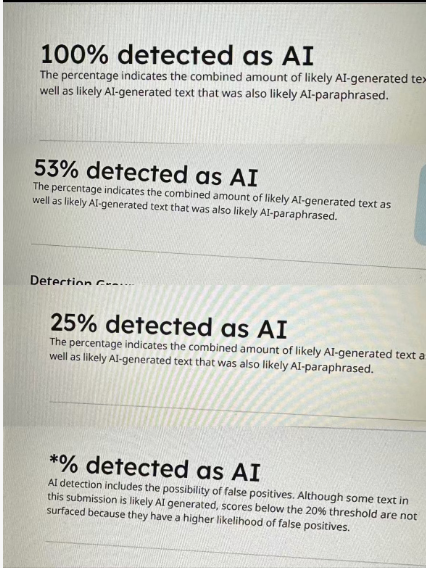
This question sits at the heart of the ongoing debate surrounding AI content detection and represents the core tension in the field. The answer requires careful distinction between what AI humanization truly entails and the unrealistic expectations sometimes placed on humanization tools.
Humanization ≠ Guaranteed Undetectability
A critical misconception that pervades discussions of AI humanization is the belief that humanizing text automatically makes it undetectable. This assumption fundamentally misunderstands both the nature of humanization and the sophistication of modern detection systems.
True humanization involves much more than surface-level modifications. Genuine humanization techniques include:
- Comprehensive rewriting that transforms the underlying structure and logic of the content
- Restructuring sentences and paragraphs to create natural, unpredictable flow
- Varying rhythm through deliberate manipulation of sentence length and complexity
- Adding contextual information that reflects genuine understanding and research
- Incorporating reasoning that demonstrates authentic analytical thinking
- Injecting personal perspective and unique viewpoints that reflect human experience
These techniques go far beyond simple word substitution or minor editing. They require transforming AI-generated content at a fundamental level to create text that genuinely resembles human thought and expression.
Learn More:7 Skills to Make Your Writing Undetectable
Learn More:Bypass AI Detection with AI Humanizer Free Online
What Humanization Is Not
Many users approach AI humanization with the expectation that simple interventions will suffice. AI humanizer tools that rely exclusively on synonym replacement, minor rewording, or superficial adjustments consistently fail to achieve reliable results against modern detection systems.
The 2025-2026 update to Turnitin’s AI detection technology marked a significant turning point in this arms race. Detection systems have grown sophisticated enough to recognize not just individual word choices but the underlying patterns that characterize machine-generated content. Simple paraphrasing or synonym substitution fails to alter these fundamental patterns.
The Ethical Dimension
The question of whether humanized AI text should avoid detection raises important ethical considerations. Using AI to generate content and then humanize it to pass detection tools may constitute deception in many contexts—academic assignments, professional writing, journalistic content, and other situations where authentic human authorship is expected or required.
Is AI humanization ethical? This question doesn’t have a simple answer. Humanization can serve legitimate purposes when used to improve readability and natural flow of AI-assisted content that is appropriately disclosed. However, it becomes ethically problematic when used to deceive readers or evaluation systems about the true nature of content authorship.
What Effective Humanization Can Achieve
When performed correctly, AI humanization can significantly reduce the detectability of AI-generated content while maintaining the original meaning and improving overall quality. The goal should not be to “bypass AI detection” through deception but rather to create content that genuinely reads naturally and provides value to readers.
The most effective approach combines technological tools with human oversight, ensuring that humanized content meets high standards for quality, accuracy, and authenticity.
Best Practices to Humanize AI Content
Creating AI content that passes detection while maintaining quality requires a thoughtful, multi-faceted approach. The following checklist represents best practices for anyone seeking to humanize AI-generated text effectively and ethically.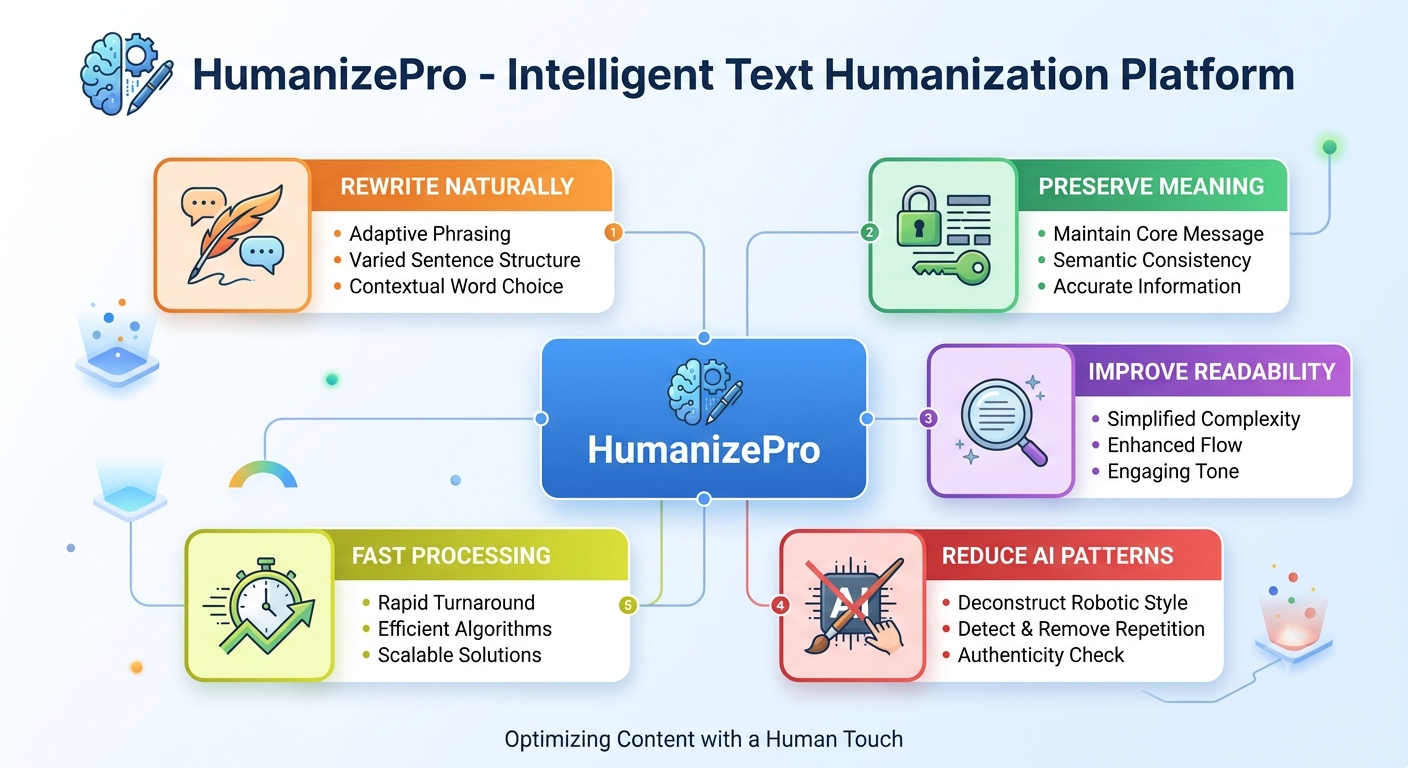
✅ Use Varied Sentence Lengths
Mix short, impactful sentences with longer, more complex constructions. Human writing naturally oscillates between concise declarations and elaborate explanations. Aim for a rhythm that feels organic rather than mechanical.
✅ Add Concrete Examples
AI-generated content often relies on abstract statements and general observations. Inject specific, tangible examples drawn from real-world experience, research, or observation. Concrete details signal genuine understanding and human perspective.
✅ Replace Clichés and Generic Phrases
AI text frequently employs overused phrases and conventional wisdom. Identify and replace these with fresh language, unexpected angles, or unconventional framings that demonstrate original thinking.
✅ Break Predictable Flow
Avoid the formulaic paragraph structures that AI models tend to produce. Vary your topic sentences, experiment with paragraph length, and create logical connections in unexpected ways. The goal is a reading experience that surprises and engages.
✅ Write Naturally
Read your content aloud. If it sounds stilted, overly formal, or mechanical, it likely exhibits AI patterns. Write the way you speak, incorporating colloquialisms, contractions, and conversational rhythms where appropriate.
✅ Include Personal Insight
Share your own perspectives, experiences, and interpretations. Personal voice cannot be manufactured by AI humanizers—it must come from genuine human engagement with the content.
✅ Vary Transition Strategies
Instead of relying on formulaic transition words, use varied techniques for moving between ideas: implicit connections, brief pauses, thematic echoes, and structural shifts that create natural flow without obvious linguistic scaffolding.
✅ Add Context and Nuance
AI content often treats complex topics in simplified, one-dimensional ways. Add contextual complexity, acknowledge counterarguments, and present information with the nuance that reflects genuine engagement with a topic.
✅ Incorporate Emotional Range
Human writing naturally conveys emotion—enthusiasm, skepticism, curiosity, doubt. AI text tends toward emotional neutrality. Appropriate emotional coloring makes content feel more authentically human.
✅ Verify and Enhance Accuracy
AI can generate plausible-sounding but incorrect information. Human review should verify facts, correct errors, and enhance content with accurate, up-to-date information that reflects current reality.
Humanize Detect vs Traditional AI Detection: A Comprehensive Comparison
Understanding the distinction between humanization-focused detection tools and traditional AI detection systems is crucial for navigating the current landscape of content authenticity verification.
| Feature | Humanize Detect Tools | Traditional AI Detection |
|---|---|---|
| Primary Purpose | Humanize AI text to appear natural | Identify AI-generated content |
| Target Users | Content creators, marketers, writers | Educators, publishers, employers |
| Approach | Transformative rewriting | Pattern analysis and classification |
| Effectiveness | Varies by tool and content type | Improving with technological advances |
| False Positives | Lower for well-humanized content | Higher for technical or formal writing |
| Speed | Real-time processing available | Near-instant analysis possible |
| Transparency | Often proprietary algorithms | Increasingly documented methods |
| Ethical Framework | Often unclear | Generally focused on authenticity |
| Evolution | Adapting to detection improvements | Continuously learning new patterns |
Traditional AI detection tools like GPTZero, Turnitin, and Originality.ai focus on identifying the statistical and linguistic signatures of AI-generated text. These systems excel at flagging content that exhibits characteristic AI patterns but may struggle with content that has been thoroughly humanized or with technical writing that naturally exhibits some AI-like characteristics.
AI detection checkers in this category analyze text against learned patterns of AI output, providing probability scores or binary determinations of AI authorship. They serve essential functions in academic integrity, content verification, and authenticity assurance.
Humanize detect tools, by contrast, take a proactive approach—transforming AI-generated content to reduce its detectability. The most sophisticated tools in this category combine multiple transformation strategies: structural rewriting, vocabulary variation, rhythm manipulation, and stylistic enhancement.
Which AI Humanizer Works Best?
The market for AI humanization tools has exploded in response to growing detection capabilities. Choosing the right tool requires understanding the strengths and limitations of different approaches.
Introduction to HumanizePro
Among the available options, HumanizePro has emerged as a leading solution for those seeking to create natural-sounding, humanized content. This tool exemplifies the sophisticated approach required for effective AI humanization in 2026.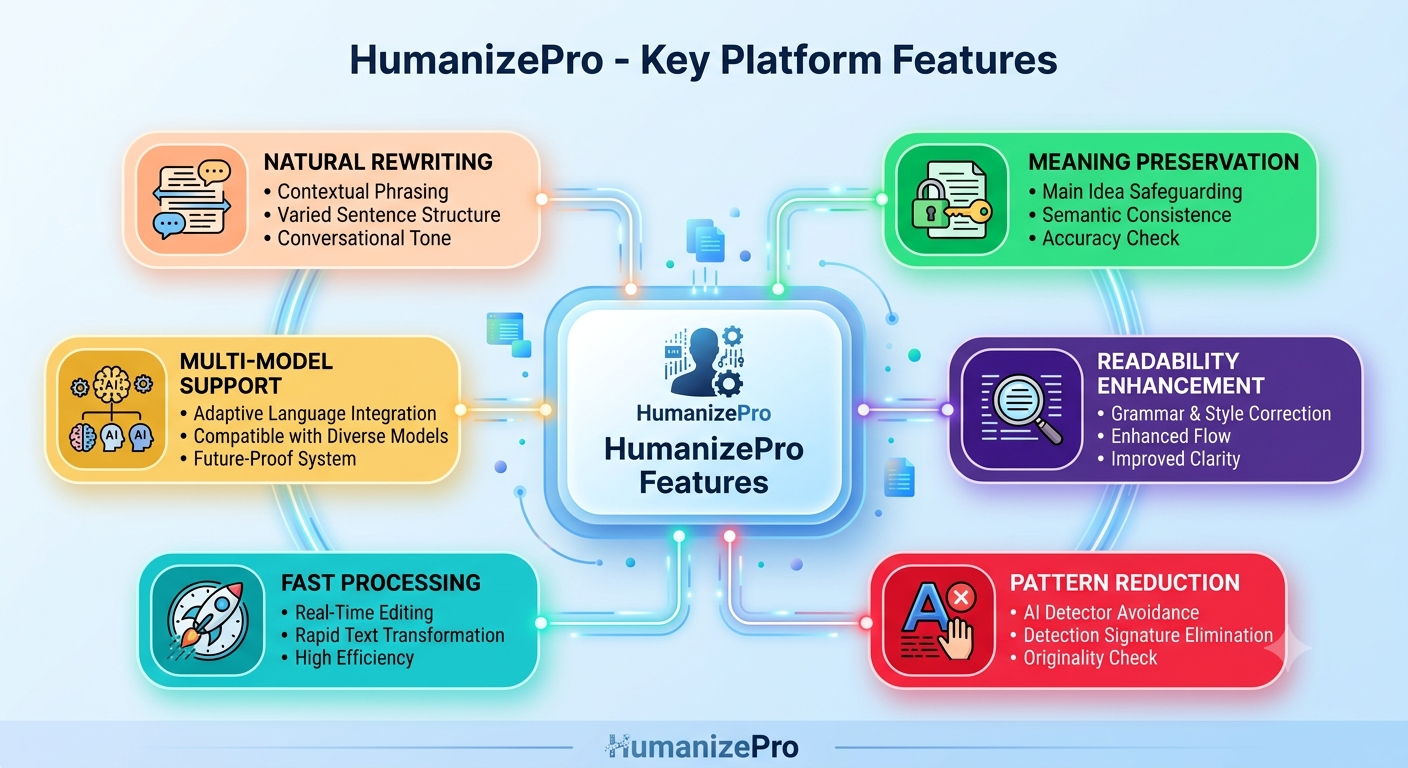
HumanizePro Features:
- Natural Rewriting: Transforms AI-generated text into organic, flowing prose that reads authentically human
- Meaning Preservation: Maintains the original message and key points while improving naturalness
- Readability Enhancement: Improves overall readability scores while preserving technical accuracy
- Pattern Reduction: Systematically reduces identifiable AI patterns without sacrificing content quality
- Fast Processing: Enables efficient humanization of large volumes of content
- Multi-Model Support: Works effectively with content from various AI sources including ChatGPT, Claude, and Gemini
Other Notable AI Humanizer Tools
The market includes several other significant players:
Originality.ai AI Humanizer: Leveraging detection expertise to inform humanization strategies, this tool offers integrated detection and humanization capabilities.
HIX Humanize AI: Known for strong performance across non-English languages and diverse content types.
Undetectable AI: Features adaptive algorithms that evolve with detection technology, though premium pricing limits accessibility.
QuillBot: More limited in humanization effectiveness against sophisticated modern detectors, but offers basic paraphrasing capabilities.
Top 6 AI Humanize Tools in 2025
Choosing the Right Tool
The best AI humanizer depends on specific use cases, content types, and quality requirements. Consider factors including:
- The sophistication of detection systems you need to bypass
- Volume requirements and processing speed needs
- Budget constraints and pricing models
- Language and content type compatibility
- Integration requirements with existing workflows
Frequently Asked Questions
What is Humanize Detect?
Humanize Detect refers to the technology and methodology for both detecting AI-generated content and transforming such content to appear more human-written. It encompasses detection tools that identify AI patterns and humanization tools that reduce those patterns while maintaining content quality.
Is Humanize Detect accurate?
Modern AI humanization detection achieves high accuracy rates, though no system is perfect. Detection accuracy depends on the sophistication of the detection algorithm, the quality of humanization applied, and the specific content being analyzed. Leading detection tools report accuracy rates above 95% for clearly AI-generated content, though humanized content presents greater challenges.
Can Humanize Detect detect ChatGPT?
Yes, most sophisticated detection systems can identify content generated by ChatGPT. However, thoroughly humanized ChatGPT content may evade detection depending on the humanization quality and the detection system’s sophistication.
Does rewriting remove AI detection?
Simple rewriting may not reliably remove AI detection signatures. Effective removal of AI detection requires comprehensive transformation that addresses underlying patterns, not just surface-level word changes. The most reliable approach combines algorithmic humanization with human editing and enhancement.
Is AI humanization ethical?
The ethics of AI humanization depend on context and intent. Humanizing AI-assisted content for disclosed AI-assisted writing is generally acceptable. However, using humanization to deceive readers or evaluation systems about true authorship raises ethical concerns that vary by situation and industry standards.
Can Turnitin detect humanized AI?
Turnitin’s 2025-2026 detection updates have significantly improved its ability to detect humanized AI content. While sophisticated humanization may reduce detectability, Turnitin’s evolving technology continues to close the gap.
What’s the difference between AI detection and AI humanization?
AI detection identifies content likely generated by artificial intelligence through pattern analysis. AI humanization transforms AI-generated content to appear more naturally human-written. These represent opposing approaches: detection seeks to identify AI content, while humanization seeks to disguise it.
Which AI humanizer is best?
The best AI humanizer depends on specific needs. HumanizePro offers comprehensive features and strong results. Originality.ai provides integrated detection and humanization. For budget-conscious users, tools like HIX offer solid performance. The ideal choice depends on volume requirements, quality standards, and budget constraints.
Continue Reading: Turnitin AI Detection Explained
Understanding what Humanize Detect is is only the first step. The next question many students, educators, and writers ask is even more practical:
How does Turnitin actually detect AI-generated writing?
Turnitin has become one of the most widely discussed AI detection platforms in education, but there are still many misconceptions about how it works, what its AI score means, and whether a high score automatically indicates academic misconduct.
In our next guide, Turnitin AI Detection Explained, we’ll explore:
- How Turnitin’s AI detection technology works
- What Turnitin’s AI percentage really means
- Whether Turnitin can detect ChatGPT, Claude, or Gemini
- Common myths about Turnitin AI detection
- Practical tips for writing naturally while maintaining academic integrity
If you’re using AI-assisted writing for school or research, this guide is the perfect next read.